

Businesses give the IRS W-9 form, or Request for Taxpayer Identification Number and Certification form, to contract or non-employee workers. The recipient fills out the W-9 and returns it to the business, not the IRS, so that the business can use the W-9 information for their own tax reporting.
You can find the W-9 form here. This form has been set up with fillable form fields to make it easy for non-employee workers to fill out.
Disclaimer: PDF.Live is not providing legal, tax or related professional advice. For guidance on your specific situation, consult a qualified employment attorney or tax professional, as form requirements vary by jurisdiction and change frequently.
What is the Request for Taxpayer Identification Number and Certification Form?
The W-9 form collects the non-employee worker’s information, including their taxpayer identification number (TIN), Social Security number (SSN), individual taxpayer identification number (ITIN), or employer identification number (EIN).
Businesses usually save W-9 forms to use the information at the end of the year when reporting taxes. They are not typically required to send W-9s to the IRS. The business checks the W-9 worker information and then reports how much they were paid that year on a separate 1099 form. 1099 forms are required if a worker or contractor earned more than $600 (as of 2026).
What Goes in a W9 Form?
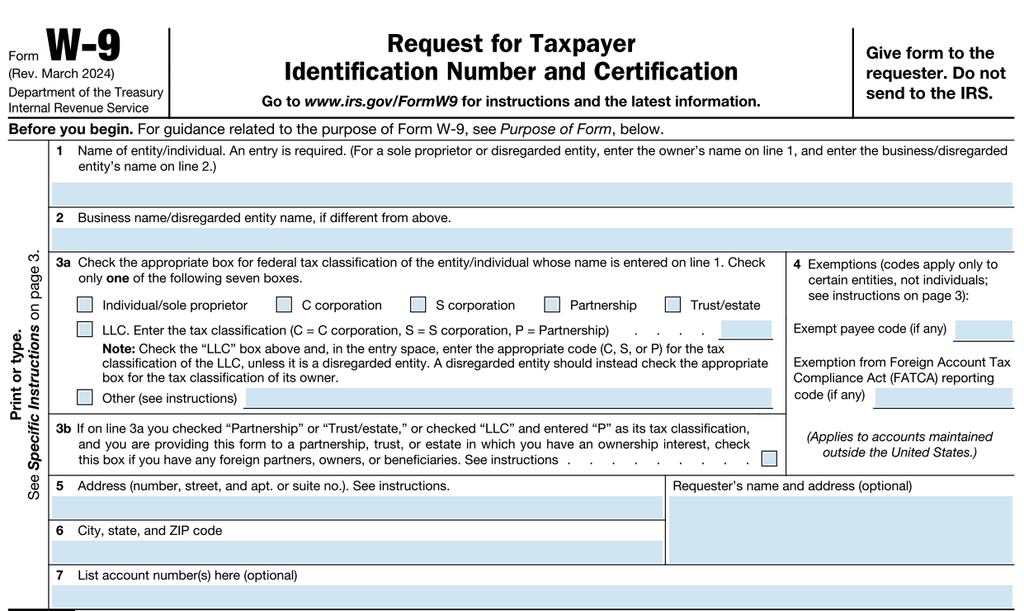
Line 1: Worker/entity name
Line 2: Business name (if different from entity name)
Lines 3a and 3b: The tax classification of the entity/individual. If it’s a worker, they’re an individual or sole proprietor. If it’s a vendor, it may be an LLC, partnership, or corporation.
Line 4: The exemption code, only applicable to business entities, not individuals. If one of these codes is present, it means that the entity is exempt from backup withholding (a 24% tax if a correct TIN isn’t provided) or FATCA reporting (unreported/underreported interest/dividend income). Refer to page 3 of the W-9 form for the exemption codes.
Line 5: The business or individual’s street address
Line 6: The business or individual’s city, state, and ZIP
Line 7: An account number, which is optional
Part I
The worker’s Taxpayer Identification Number (TIN), which is either a Social Security Number (SSN) or Employee Identification Number (EIN), goes in this space. For non-employee workers, the business uses the TIN for reporting taxes to the IRS. Individuals typically provide an SSN. Businesses typically provide an EIN.
Part II
The worker uses this to certify the information on the W-9 is accurate. They sign and date the W-9. A signature certifies that the information on the form is correct, the worker is a U.S. citizen or U.S. person as defined on page 2, any exemption code listed is correct, and the worker is not subject to backup withholding.
FAQs About W-9 Forms
Where can I get a blank W9 form online?
You can find a W9 form to fill out online in the PDF.Live forms library.
Where do I send a W-9 form?
If you are a contract employee or worker, send the W-9 form back to the employer. If you are an employer, keep W-9s on record for use when you complete 1099s at the end of the tax year. Businesses must keep W-9s on file for four years to reference if the IRS asks questions about the business or individual.
What is the purpose of a W-9 form?
A W-9 form collects a taxpayer identification number (TIN) for an individual or business. When a business reports that they paid non-employee wages or vendor fees, they need a TIN so the IRS can correctly identify who was paid.
Who needs to fill out a W-9 form?
Non-employee workers, contractors, and vendors need to fill out a W-9 form and return it to the business that’s paying them. Businesses provide the W-9s and then keep the completed forms on file. You can also access a fillable W-9 form online.
What is the difference between a 1099 and a W-9?
The main difference between a W-9 and 1099 is that the W-9 is an information-collection form and the 1099 is a reporting form. The worker or contractor completes the W-9 to provide their tax identification and other information. At year-end, the business uses that W-9 information to complete and issue the 1099-NEC form (non-employee compensation), which reports how much they paid the contractor. Contractors then use the 1099 to report the income on their tax return.
What is the difference between a W-9 and a W-2?
The key difference between a W-9 and a W-2 is that the latter is for wage reporting. W-9 is an information form to provide tax information from non-employee workers, contractors, and vendors to a business. Employees receive W-2s at the end of the year. They report wages, taxes and other withholdings. With a W-9, the contractor pays their own taxes; with a W-2, the employer handles withholding.
Should I keep a copy of my W-9?
You can keep a copy of your W-9, but you aren’t required to. It’s a good idea to keep a copy, so you can compare against your 1099. Employers keep them to use when they issue 1099s at the end of the year.